

A Unified Ledger for Every Payment
RASEDI’s ledger system gives your business a single source of truth for all payment activity. Every authorization, capture, refund, payout and fee is recorded as a precise ledger entry, so finance, operations and product teams always see the same numbers—no more fragmented spreadsheets or mismatched reports.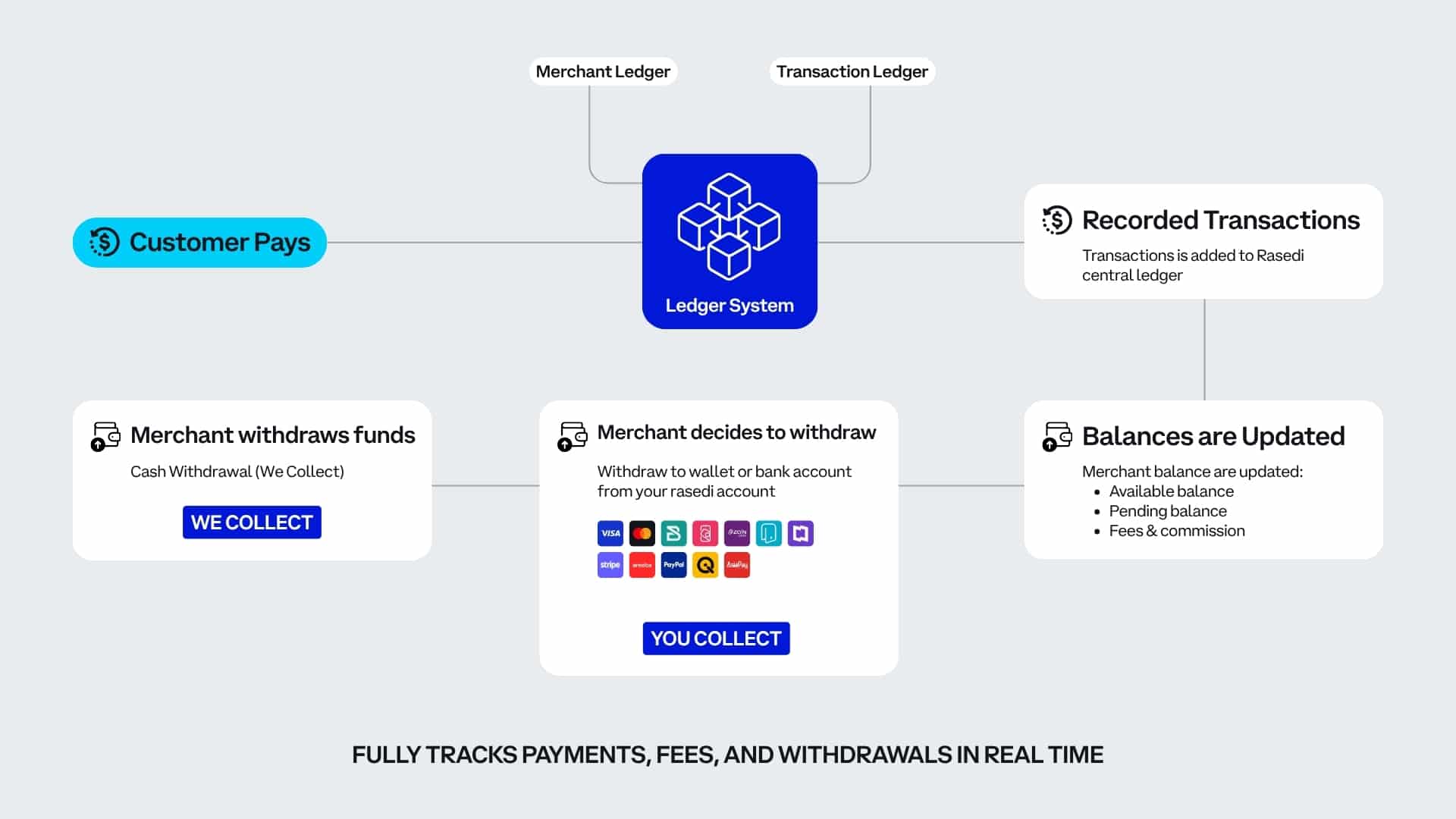


Single source of truth
RASEDI’s ledger system records every payment, refund, fee and payout in one unified place, giving finance and operations a consistent, trusted view of balances across customers, merchants and channels.
Accounting‑grade transparency
Each money movement is logged with clear references and timestamps, creating a detailed audit trail that makes it easy to trace a transaction from initial authorization through settlement in the bank.
Built for platforms and marketplaces
The ledger separates your own funds from those held for merchants or partners, supports commissions and revenue‑sharing, and maintains sub‑ledgers so you always know who owns what, and when.
Faster reconciliation and reporting
Structured ledger entries simplify matching provider statements to internal records and power rich reporting, helping your team close the books faster and make better, data‑driven decisions.
The leading
ledger first fintech platform in Kurdistan and Iraq
RASEDI is the first fintech platform in Kurdistan and Iraq built from the ground up around a dedicated ledger system, putting accurate money movement at the core of every product. This ledger‑first architecture gives banks, merchants and platforms unmatched transparency, control and reliability over their payments, settlements and balances.
What is the Ledger?
The RASEDI Ledger is an accounting‑grade record of every movement of funds across your customers, merchants, partners and bank accounts. Instead of relying only on provider dashboards, you work with a consistent internal ledger that mirrors how money flows through your business, down to the smallest fee.

Clarity, control and confidence
As payment volumes grow, reconciling gateways, banks and platforms becomes harder. RASEDI’s ledger system centralizes this complexity so you can close the books faster and trust your numbers.From transaction to settlement
Whenever a payment event happens—such as an authorization, capture, refund or chargeback—RASEDI automatically writes balanced entries to the ledger. These entries update the balances of the relevant parties (customer, merchant, platform, bank) and are linked to the original payment request.

Built for platforms and marketplaces
For platforms, marketplaces and aggregators, the ledger system separates funds that belong to your business from funds held on behalf of others. You can define who gets paid, in what share and on what schedule, while keeping every split visible.Audit‑ready by design
The ledger system is designed to support strong internal controls and audit requirements. Immutable records, time‑stamped entries and clear references between events help demonstrate how funds move through your business.

Turn ledger data into insights
Because every transaction is recorded in the ledger, reporting becomes straightforward. Finance and operations teams can see movements over time, drill down to individual transactions and export structured data to their accounting or BI tools.Bring order to your payments with RASEDI’s Ledger System
Frenquently Asked Questions
1. What is the RASEDI Ledger System and why is it important?
The RASEDI Ledger System is an accounting‑grade foundation that records every movement of money across your customers, merchants, partners and bank accounts. Instead of relying only on individual gateway dashboards or bank statements, you work with a single, internal system of record that mirrors how funds actually flow through your business. This provides consistency for finance and operations, eliminates blind spots between providers and channels, and becomes the reference point for reconciliation, reporting and audits.
2. How is the ledger different from normal payment transaction logs?
Typical transaction logs simply state that a payment succeeded or failed, often without capturing detailed balance movements or subsequent events like partial refunds, split payouts or adjustments. The RASEDI Ledger, by contrast, records each of these steps as structured, balanced entries that reflect who the money belongs to and when it becomes available. This means you can reconstruct the full lifecycle of a payment—including fees, currency conversions and settlements—rather than just seeing isolated events.
3. Does the RASEDI Ledger use a double‑entry accounting model?
Yes. The system is designed using principles similar to double‑entry accounting, where every movement of value is represented by at least two offsetting entries. For example, when a customer pays, the ledger increases the platform or merchant’s receivable balance and records corresponding liabilities to the acquirer or bank. When funds are settled or paid out, new entries reverse the receivable and reduce liabilities. This structure helps prevent imbalances, supports accurate financial statements and makes it much easier to spot discrepancies.
4. What payment events are recorded in the ledger?
Every key stage in the payment lifecycle is captured as ledger entries: authorizations, captures, voids, refunds, chargebacks, payouts, chargeback reversals, fee charges and manual adjustments. The ledger also records non‑payment movements such as balance corrections or operational credits and debits when those are required by your business logic. Each entry is linked back to the original payment request, merchant, customer reference and settlement batch, providing full traceability from order to bank statement.
5. How does the ledger system help with reconciliation and closing the books?
Because all movements are normalized into the same data model, finance teams can reconcile faster against gateway reports and bank statements. Instead of matching each provider’s export separately, you can compare their totals with the RASEDI Ledger for a given day, currency or settlement batch. Any differences are easier to isolate because each entry has a clear origin and timestamp. This reduces manual spreadsheet work, shortens month‑end closing cycles and lowers the risk of human error.
6. Can the RASEDI Ledger support marketplaces and multi‑party flows?
Yes. The ledger is designed to handle complex platform models where a single customer payment must be split between multiple parties—for example, a marketplace commission, vendor payout and tax component. The system maintains sub‑ledgers and balances per merchant, branch or partner, while tracking what portion of each transaction belongs to your business versus third parties. Configurable fee and revenue‑share rules are applied as entries at settlement time, so you can always see exactly how each payment was allocated.
7. How does the ledger system manage multiple currencies and FX?
The ledger stores the currency and amount of each movement, allowing you to maintain balances in the original transaction currency as well as in your chosen reporting or settlement currency. When FX is involved, the system records explicit entries for the converted amounts and any spread or fees related to currency exchange. This transparency helps you understand your true FX costs, supports multi‑currency settlements, and enables more accurate margin analysis in cross‑border scenarios.
8. What tools are available to access ledger data (dashboards, exports, APIs)?
RASEDI exposes ledger data in several ways so that both technical and non‑technical teams can work with it effectively. Operations and finance teams can use dashboards to filter by date, merchant, currency, payment method or settlement batch and drill down to individual entries. For deeper analysis or integration with accounting and BI systems, exports and APIs can be used to pull structured ledger records on a scheduled or on‑demand basis. This flexibility lets you embed ledger insights into your existing workflows without duplicating data.
9. How does the ledger contribute to security, compliance and audits?
A robust ledger is a core control for regulated and fast‑growing businesses. RASEDI’s approach—immutable records, time‑stamped entries, and clear referencing between events—provides an audit trail that shows exactly when and why balances changed. This supports internal control frameworks, external financial audits and regulatory reviews, particularly in areas such as safeguarding of client funds, settlement discipline and accurate reporting of fees and commissions. Because ledger data is consistent and centrally managed, your teams spend less time assembling evidence and more time reviewing insights.